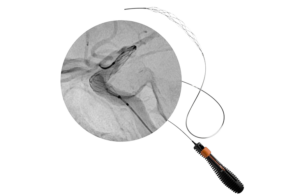
The company also reported the first clinical cases using the device in treating large vessel occlusion (LVO) stroke.
Designed specifically for large clot burden in proximal vessels, Tigertriever 25 combines a 53 mm capture length with proprietary real-time force control. This enables physicians to actively control clot interaction during procedures. The company said this produces consistent performance across a range of clinical scenarios, including long thrombi and stenotic vessels.
Rapid Medical describes Tigertriever 25 as the largest thrombectomy device available. It specifically engineered the device to address occlusions in proximal vessels, such as the internal carotid artery (ICA) and M1 segment. The device combines extended capture length, active operator-controlled expansion and a distal net. This helps maintain clot engagement over long segments to help reduce clot fragmentation and distal embolization.
Tigertriever 25 expands Rapid Medical’s large clot burden portfolio, building on previous versions of the device. The Tigertriever 13 received FDA clearance for LVOs in 2022.
Commentary from doctors using the Rapid Medical technology
Dr. Edgar Samaniego, University of Iowa, who performed the first U.S. case, said:
“With every thrombectomy, we aim at our first pass being the last. The Tigertriever 25 demonstrated excellent conformability to the vessel anatomy, accommodating the MCA diameter with a smooth transition into the terminal ICA. This adaptability allows for effective engagement across long segments and makes it particularly valuable in large vessel occlusions with high clot burden, even in challenging, angulated anatomy.”
Dr. Demetrius Lopes of Advocate Health Care added:
“Acute ischemic stroke intervention today demands a diverse and adaptable toolkit to effectively address the wide spectrum of anatomical and clinical scenarios we encounter, and I am very impressed with the versatility of the Tigertriever 25 device. Its design streamlines the procedural approach and has the potential to simplify the pathway to achieving first-pass success—an outcome that remains critical for improving patient outcomes in mechanical thrombectomy.”