
Medical device companies have many factors to consider when deciding which adhesives to use with tubing. An adhesives manufacturer explains them.
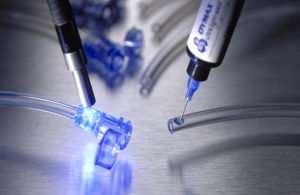
Determining the right adhesive technology for your medical tubing depends on several factors, according to experts at Dymax, a Torrington, Conn.–based manufacturer of advanced light-curable adhesives, coatings, oligomers, light-curing equipment and fluid dispense systems.
Factors to consider include:
- What is the tubing made of?
- What will it be used for?
- How much volume will you need to produce?
- What is the device’s design?
- How will it be sterilized?
Thermoplastic materials such as nylons and their derivatives can resist harsh chemicals and environmental end-use conditions. They’re strong and can withstand a variety of sterilization methods. Polyether block amide (PEBA) is a lightweight material that offers low friction properties, kink and pressure resistance, softness and flexibility and is chemically, fatigue and impact-resistant.
Cyclic olefin polymers and copolymers (COC and COP) are amorphous polymers that offer an alternative to glass for prefilled syringes and serum vials due to their purity, moisture resistance, clarity and sterilization compatibility.
Medtech companies that manufacture devices that use small, lightweight tubing may need an alternative to mechanical fasteners to assemble their plastic parts. Their device’s intended use may not allow for gaps produced by ultrasonic welding or fusion bonding, or the cracks that may develop in plastic substrates subjected to solvent welding.
That’s where adhesives come in, according to Michelle Evanoski, medical adhesives product manager for Dymax. Adhesive technologies can deliver high-strength bonding, sealing, gap-filling and in-line processing. Although they require time to set and cure, some adhesives can easily bond a variety of dissimilar substrates, as well as sealing the bond line, Evanoski said.
Certain plastics bond more easily than others. Nylon, COC/COP and PEBA are all difficult-to-bond thermoplastics because of their low surface energies and smooth or glossy surfaces, Evanoski explained.
Adhesives are also polymers and can either spread out, in a process called “wetting,” or bead up on the surface of a plastic substrate. The ones that bead up will not fill in irregularities on the substrate surface, making chemical bonding difficult. Manufacturers can use a variety of techniques to activate a substrate or change its surface to improve adhesion: grit blasting, micro blasting and sanding will scratch the surface to expose crystalline microstructures within the substrate with different wetting characteristics.
While these abrasion methods remove a layer of the substrate’s surface, others such as corona discharge, add a layer. Plasma treatment shoots argon, nitrogen, oxygen or helium onto the surface to add acetal, carboxyl or hydroxl groups to it, increasing surface energy and thus, bonding strength. Chromic acid can etch the substrate to drastically improve wetting for a stronger bond. Flame treatments will melt the surface and add a reactive layer of oxidation.
All these techniques can make a smooth substrate more amenable to bonding when using an adhesive, Evanoski said.
Once the adhesive is applied, it must cure. Adhesives cured with light rather than heat offer unlimited time for manufacturers to adjust parts. Then the adhesives can cure on-demand when exposed to the appropriate light wavelength, hastening the assembly process.
For high-volume, high-speed, automated production, UV/Visible light-curable adhesives can fully cure in seconds into thermoset polymers, Evanoski said. These form lasting bonds to different types of plastics, including those that are difficult to bond. These adhesives can come with fluorescing properties that enable easy inspections to detect bonding, coverage and volume. Some adhesives can change color to help manufacturers confirm they have cured completely.
Many light-curable adhesives are formulated to enable visual confirmation of their placement, either by the human eye or by automated vision systems. These include formulations that change from a bright color when uncured to colorless when they’re cured. Those formulated with fluorescent dyes remain colorless until they are exposed to a black light, which will cause them to fluoresce either red or blue. Adhesives that fluoresce red work well with substrates that naturally fluoresce blue, such as PVC and PET, and allow for easy inspection of bond lines, Evanoski said.
With so many factors to consider in choosing an adhesive technology, medtech manufacturers should look for a partner who can offer guidance through engineering, R&D, sales and technical service, she added. Thorough testing of prototypes on simulated production lines can include dispense/dwell times, wavelength selection and cure time, and pull evaluations to ensure successful assembly and a well-performing device.