“Annuloplasty has served as the foundation of more than 95% of surgical mitral valve repairs for decades,” said Valcare Medical CEO Steve Sandweg. “Applying this proven surgical technique through a percutaneous, transcatheter approach represents a significant step forward.”
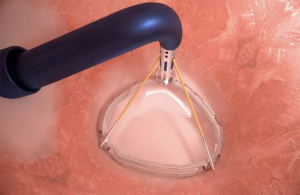
The Amend system delivers a closed, D-shaped, semi-rigid annuloplasty ring through a catheter in a transseptal approach. It was designed to mimic the anatomical remodeling and clinical results of traditional surgical annuloplasty, but as a minimally invasive alternative for patients not suitable for open-heart surgery. Traditional surgical annuloplasty is typically performed by making an incision in the chest to access the heart.
Interventional cardiology expert, Dr. Paul Sorajja performed the breakthrough procedure at Banner – University Medical Center in Phoenix, Arizona.
“For many patients with mitral regurgitation, open-heart surgery is either too risky or simply not an option due to age or other health conditions,” said Dr. Sorajja. “The Amend transseptal approach offers physicians a percutaneous alternative designed to deliver a surgical-style repair option for their patients with less pain, faster recovery, and the potential for excellent long-term outcomes.”
Amend features a docking station for valve replacement procedures and is compatible with a combination of future interventions such as transcatheter edge-to-edge repair (TEER), chordae adjustments or leaflet modifications, if required later.
Valcare’s CEO and Chief Medical Officer, Dr. Davin Meerkin, spoke in our DeviceTalks Cardiac Innovations webinar series earlier this month about the unmet need with existing transcatheter mitral valve repair and the technology behind their Amend system.
The novel system’s investigational device exemption application to commence an early feasibility study was approved by the FDA in March 2025. The study is a prospective, single-arm study evaluating the safety and performance of the Amend system in 15 patients with moderate to severe symptomatic mitral regurgitation who are anatomically suitable for transcatheter annuloplasty.
Patients in the study will be monitored for five years, checking in with researchers at predetermined times to evaluate the device’s safety and efficacy in vivo.