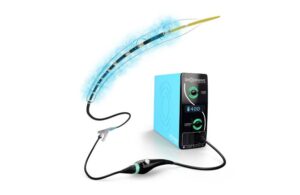
Johnson & Johnson MedTech‘s Shockwave Medical today announced one-year results supporting the use of its Shockwave peripheral IVL system.
Shockwave shared findings from DISRUPT BTK II. The post-market study evaluates the safety and effectiveness of the company’s intravascular lithotripsy (IVL) system for the treatment of calcified lesions below the knee (BTK) in patients with peripheral artery disease (PAD).
The company shared its positive results a year after the first release of 30-day data supporting the IVL platform. Its IVL technology uses sonic pressure waves to treat people with calcified arterial plaque. A catheter-based treatment, it can help restore blood flow by cracking calcium lesions. Its uses include in both coronary artery disease (CAD) and PAD, often in combination with stenting.
Shockwave said its trial includes “some of the most challenging patients studied to date.” It included a high proportion of patients with chronic limb-threatening ischemia (CLTI). Results, presented at the annual Vascular InterVentional Advances (VIVA) meeting in Las Vegas, confirm the durability of IVL BTK. Findings demonstrated symptom relief, limb salvage and improved quality of life.
“Treating patients with complex BTK lesions has always been a major challenge with limited options available. DISRUPT BTK II sets a new standard by introducing IVL as a frontline strategy to modify calcification and restore vessel compliance for this high-risk patient population,” said Dr. Ehrin Armstrong, interventional cardiologist and medical director, Adventist Heart & Vascular Institute, who presented the data. “Shockwave IVL is one of the first technologies rigorously tested in severely calcified lesions, delivering low amputation rates and meaningful symptom relief—a major milestone in vascular care.”
A look at the findings shared by J&J’s Shockwave
DISRUPT BTK II enrolled 250 patients with 305 lesions across 38 sites globally. It features a complex patient cohort, including 200 patients with CLTI. Shockwave said 58.5% of patients presented with no baseline wounds, 80% with CLTI, 70% with diabetes mellitus, 30% with chronic total occlusions (CTOs) and 85% with moderate-to-severe calcium.
Investigators reported that 94.8% of patients achieved freedom from major target limb amputation at one year. IVL also achieved freedom from clinically driven target revascularization in 84% of patients at one year.
The study saw durable patency observed in 67.1% of patients at one year. Three quarters (75.5%) of patients achieved Rutherford Class improvement at one year. Additionally, 61.3% of patients presented wound healing or improvement.
In the CLTI cohort, 8.1% of patients had an amputation. The proportion of patients with a CLTI Rutherford classification improved from 80.1% at baseline to 25.1% at one year. Investigators also saw significant symptomatic and VascuQoL improvements at one year. Of patients with CLTI, 82.7% remained free from DC-TLR at one year and primary patency rate came in at 64%.
“These data underscore IVL’s critical role in wound healing and helping limb preservation. By reducing amputations and helping patients preserve mobility and independence, Shockwave IVL is transforming outcomes for patients with severe peripheral artery disease,” said Dr. Venita Chandra, vascular surgeon and clinical professor, Division of Vascular Surgery, Stanford Health Care. “We will continue tracking patient outcomes through two years to evaluate the long-term durability of these compelling results, and we look forward to the additional analyses to continue to optimize outcomes in this complex, real-world patient population.”